 (Image source: Gemini)
 So what does this actually mean for you? It means we're no longer guessing. We've stopped treating the human body like a blunt instrument and started treating it like a high-performance biological engine. The shift is massive. We've moved away from generic training programs that treat every athlete the same and toward hyper-personalized plans that change based on how you slept last night. This new methodology is about longevity as much as it is about winning. By using data science and new technology, we can see exactly what's happening under the hood. You're not just training hard. You're optimizing your neurological command center and your metabolic efficiency. It's the digital equivalent of having a world-class coaching staff in your pocket at all times.
Wearable Tech and Real-Time Biometric Feedback
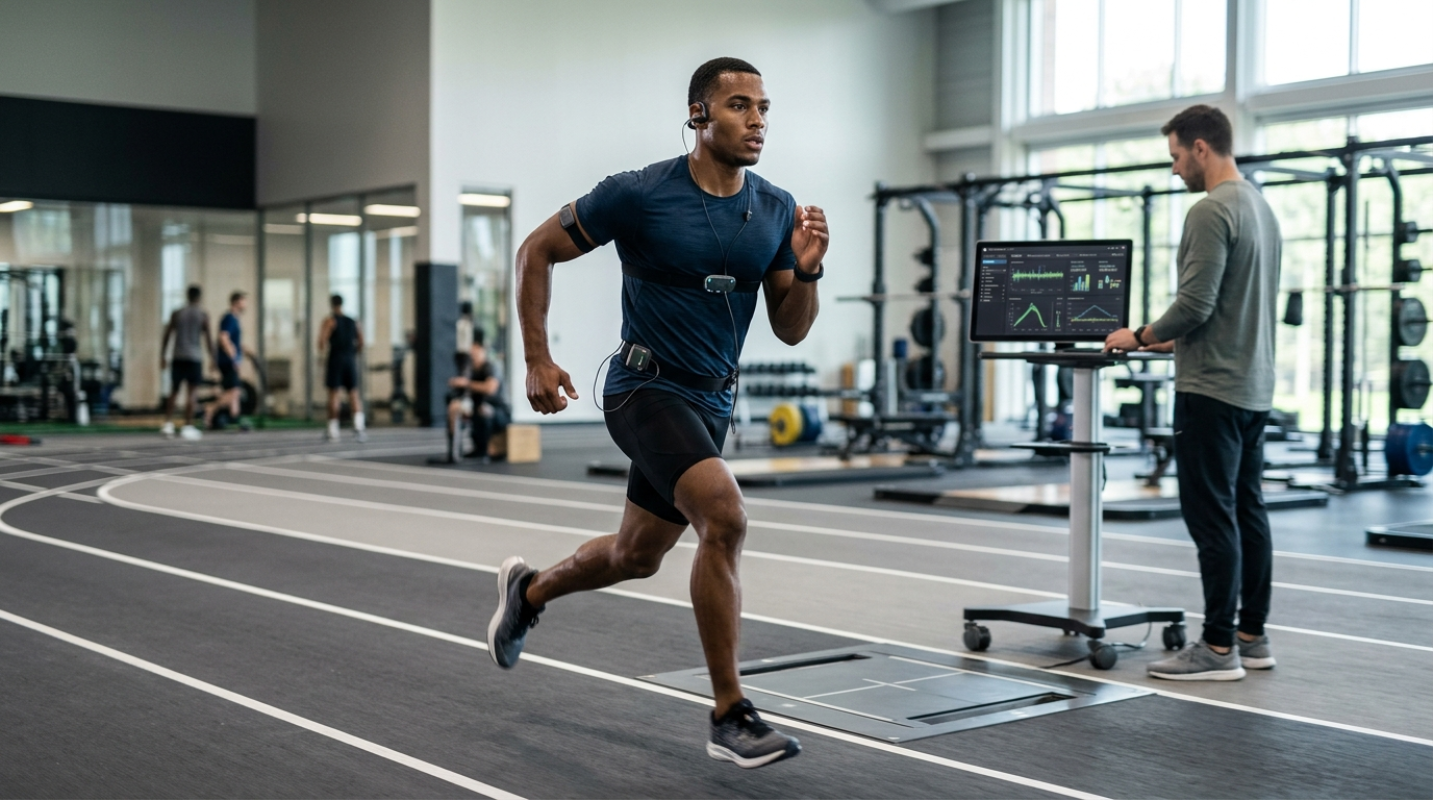
You probably already have something on your wrist, but the tech we're seeing in 2026 is miles ahead of basic step counting. Wearable technology is still the top trend in the fitness world because it's stopped just collecting data and started telling us what to do with it.¹ We've entered the age of AI-driven prescriptive coaching.
Devices like the Oura Ring Gen 4 and the Garmin Instinct 3 are doing the heavy lifting now. These tools don't just tell you that your heart rate is high. They correlate your sleep patterns with your recovery and tell you to take a rest day before you even feel tired. Have you ever wondered why some athletes seem to get injured every season while others stay healthy for years? It's often because they're monitoring internal load rather than just external volume.
The results are hard to ignore. AI-driven injury prevention systems have helped teams like LAFC slash their non-contact injury rates by nearly 70 percent. We're even seeing smart clothing from brands like Nike that have sensors woven right into the fabric. These sensors monitor how your muscles are firing and what's in your sweat. It's about preventing the injury before it happens, not just icing it afterward.
The Data-Driven Nutrition Revolution
We've all been there. You're halfway through a long run or a tough game, and you suddenly hit a wall. Your legs feel like lead, and your brain goes foggy. In the past, we called this "bonking" and just hoped a sugary gel would fix it. Now, we use Continuous Glucose Monitors (CGMs) to make sure that the wall never appears in the first place.
CGMs like the Dexcom G7 or the tiny Abbott FreeStyle Libre 3 Plus are now used by over 60 percent of high-performance athletes. These sensors give you a minute-by-minute look at your blood sugar levels. You can see exactly how a bowl of pasta or a specific energy drink affects your fuel levels in real time. It turns out that "standard" nutrition advice doesn't work for everyone because elite athletes have wildly different glucose responses during extreme stress.
But it's not just about sugar. We're seeing a huge move toward personalized gut microbiome testing and blood biomarker analysis. Athletes are taking supplements based on what their blood actually needs, not just what's popular on social media. If your body isn't absorbing nutrients properly because your gut health is off, no amount of expensive protein powder will help you. It's about metabolic precision.
Cognitive Training and Neuro-Athleticism
Have you ever noticed how the best players in the world always seem to have more time on the ball? It's not because they're faster. It's because their brains process information more quickly. This is what we call neuro-athleticism. We're finally starting to train the brain like it's a muscle, focusing on how it receives sensory info and turns it into movement.
Nike has even released footwear like the Mind 001 that uses neuroscience-driven design to help athletes stay "locked in" during competition.² Other tools like the Vector Ball or Senaptec Sensory Stations help players improve their reaction times and peripheral vision. It's about being calm under chaos. If you can process the game faster, you don't have to run as much.
We're also seeing more athletes use virtual reality (VR) for tactical simulations. This allows a quarterback or a midfielder to get 500 mental reps of a specific play without putting any wear and tear on their joints. Combine that with EEG headphones that track "Focus Scores," and you have a recipe for a much sharper athlete.³ It's the "Neuro Advantage" that breaks through performance plateaus when physical training hits a limit.
Advanced Recovery and Regenerative Modalities
Recovery used to be a bag of ice and a nap. Today, it's a "Recovery Stack" that looks like something out of a sci-fi movie. Tools that were once only for pros, like cryotherapy chambers and hyperbaric oxygen tanks, are now in the homes of serious amateur athletes. We've realized that you don't grow in the gym. You grow while you're recovering.
One of the coolest new trends is palm cooling. Devices like the Kühler Palm Cooling Device are used during rest periods to lower your core temperature quickly. This allows you to go back into your workout and do more reps because you've delayed exhaustion. It's a simple physiological hack that has a massive impact on total training volume.
Sleep has also moved from a luxury to a primary performance tool. We're seeing the rise of sleep tech like DeepSleep, which uses EEG monitoring to stabilize your deep sleep stages. This is when your body actually repairs its tissues. If you're not optimizing your circadian rhythm, you're leaving performance on the table. Even the way we rehab is changing, with Blood Flow Restriction (BFR) training allowing athletes to maintain muscle mass even when they can't lift heavy weights.
The Future of the Complete Athlete
The gap between the pros and the rest of us is shrinking. All of this technology is democratizing high-performance training. You don't need a million-dollar contract to access the same data that NFL players use.⁴ Microsoft and other tech giants are making these AI-driven insights available to anyone with a smartphone and a wearable.
But here's the catch. You can't let the data replace your intuition. The best athletes in the future will be the ones who can balance all this tech with their own internal "feel" for the game. Tech is a tool, not a crutch. It's there to help you understand your body better, not to tell you how to live your life.
As we look toward the next few years, the focus will likely shift even more toward closing the gender data gap. For too long, sports science was based almost entirely on male physiology. Now, we're seeing a massive push for female-specific training loads and recovery protocols. The future of human potential in sports isn't just about faster shoes or better sensors. It's about understanding the unique biology of every individual athlete.
This article on Athorizon is for informational and educational purposes only. Readers are encouraged to consult qualified professionals and verify details with official sources before making decisions. This content does not constitute professional advice.